This page contains affiliate links. If you make a purchase through one, we may earn a commission at no extra cost to you.
Most “best headphones” lists are written for music listening, and that’s the wrong lens for audiobooks and podcasts. A pair of headphones that sounds huge and exciting for a bass-heavy playlist can actually work against you for six hours of narration — the criteria that matter for long-form listening are almost the opposite of what gets a headphone crowned “best” in a general roundup.
If you’d rather skip ahead and just see what fits the criteria below, check current Marshall headphone models and pricing — their lineup is one of the few built around the midrange-forward tuning this page argues for, for reasons covered in detail further down.
Why Music Criteria Don’t Apply Here
Reviewers evaluate music headphones on bass extension, soundstage width, and how “exciting” the sound signature is. None of that matters for a single narrator’s voice. A voice sits almost entirely in the midrange — roughly 300 Hz to 3 kHz — and a headphone that’s been tuned with an elevated bass shelf to sound impressive on a 30-second demo track can actually muddy that range, making dialogue and narration sound thicker and less distinct than it should. The headphones that top music charts are frequently not the ones you want for eight hours of a 40-hour audiobook.
The Three Criteria That Actually Matter
1. Voice-Frequency Clarity, Not Bass Response
What you want is a relatively flat, neutral response through the midrange — clarity on consonants, no muddiness on lower male voices, no harshness on sibilant “s” sounds from narrators reading close to a microphone. Headphones marketed specifically for “vocal clarity” or “podcast/audiobook use” tend to pull back the bass shelf and avoid the treble spike that makes music headphones sound “sparkly” but makes spoken word fatiguing over long sessions.
2. All-Day Comfort
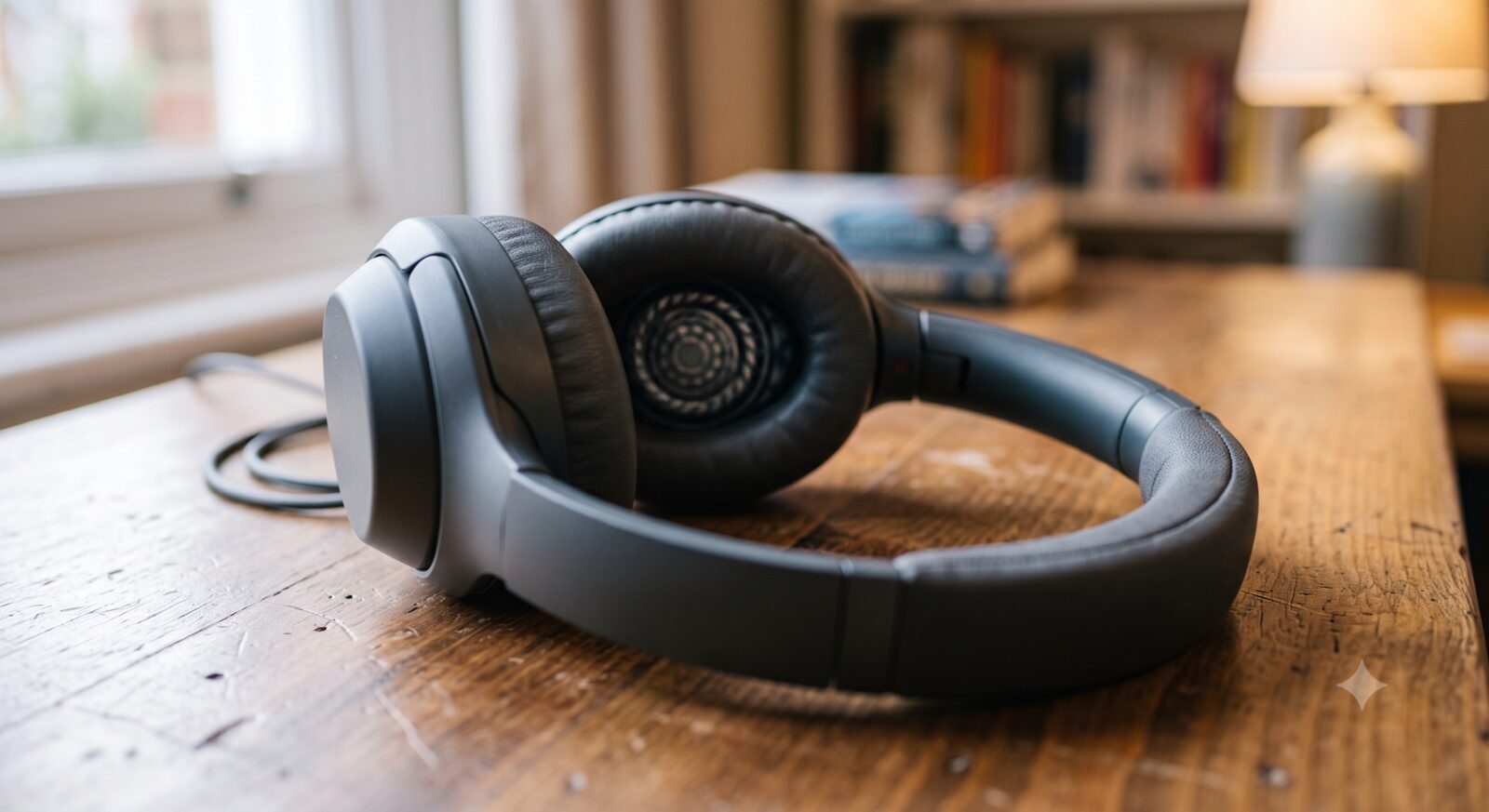
This is the criterion music reviews almost never weight heavily, and it’s the one that matters most for audiobooks. A pair that feels fine for a 20-minute review-unit test can become genuinely uncomfortable at hour four. Look for:
- Memory foam ear cushions that distribute clamping pressure instead of concentrating it on the top of the ear
- Total weight — anything under roughly 250g wears meaningfully better over multi-hour sessions than a 320g+ pair, even if the heavier pair sounds marginally better
- Adjustable, well-padded headband — a hard plastic headband with minimal padding is the single most common source of “hot spot” discomfort after 2+ hours
- Breathable ear cushion material — pleather looks premium but traps heat; a hybrid or fabric-lined cushion breathes better for long wear
3. Battery Life for Marathon Sessions
A typical audiobook runs 10-15 hours; a long fantasy or sci-fi doorstop can run 30-40+. If you’re a commuter or a long-session listener, a wireless pair advertising “6 hours” is going to interrupt your book multiple times a week with a charging break. Look for headphones in the 30+ hour range if you listen wirelessly, or just default to a wired connection for genuinely uninterrupted marathon listening — wired removes the battery question entirely, at the cost of a cable.
Where Marshall’s Headphone Lineup Fits
Marshall’s headphone line (built by Zound Industries under license) leans toward a relatively balanced, midrange-forward tuning rather than the aggressively bass-boosted signature you’d expect from the amp-stack branding — which, for audiobook use, is a genuine advantage rather than a marketing coincidence. The Major V runs light and foldable with a claimed battery life in the 100-hour range in its lowest-power mode, which comfortably covers even the longest audiobook without a mid-book charge. Full Marshall Headphones Review covers model-specific tradeoffs, including the one real caveat worth knowing before you buy: check current Marshall headphone pricing and models.
Open-Back or Closed-Back for Audiobooks?
Short answer: it depends on where you’re listening, and it’s a genuinely close call rather than one being objectively “better.” We cover this in full in Open-Back vs. Closed-Back Headphones, but the short version — open-back tends to sound more natural and stays cooler over long home-listening sessions, while closed-back isolates you from a noisy commute or open office. Neither one is wrong for audiobooks specifically; it’s a listening-environment decision more than a content decision.
Wired vs. Wireless for Long-Form Content
Bluetooth audio codecs are plenty transparent for spoken word — you’re not going to hear the compression artifacts on a narrator’s voice the way a critical listener might on complex orchestral music, so don’t let codec debates factor into an audiobook-specific purchase. The real wireless tradeoff is battery anxiety and the (small but real) audio dropout risk in crowded RF environments like a train platform or a gym. If you listen primarily at a desk or on a couch, wireless convenience wins easily. If you listen on multi-hour flights or in dead zones for charging, a wired pair — or a wireless pair with a physical cable fallback — removes the failure point entirely.
Does Headphone Choice Change for Full-Cast Productions?
Everything above assumes a single narrator reading in a roughly centered, mono-ish mix, which covers most audiobooks. Full-cast dramatized productions like GraphicAudio’s are mixed differently — multiple voice actors are placed across the stereo field along with sound effects and score, closer to a radio drama than a straight narration. That changes one thing on the checklist: stereo imaging and channel separation start to matter in a way they don’t for a single narrator, since a voice actor panned hard left needs to stay distinct from the score and effects happening elsewhere in the mix. The comfort, weight, and battery-life criteria above still apply exactly the same — a full-cast production runs just as long as a standard audiobook — but if you listen to a lot of GraphicAudio specifically, a slightly wider soundstage is worth prioritizing over the narrowest, most “focused” vocal tuning. Our full GraphicAudio review goes deeper on what the format actually sounds like; see GraphicAudio’s current catalog and pricing if you’re curious what a full-cast production is like firsthand.
A Quick Buying Checklist
- Neutral or vocal-forward tuning, not a bass-boosted “fun” signature
- Under ~250g if you’ll wear them 2+ hours at a stretch
- Memory foam or hybrid cushions, not thin pleather pads
- 30+ hour battery life for wireless, or a wired fallback option
- Foldable/travel-friendly if you listen on the go
Frequently Asked Questions
Do I need noise cancelling for audiobooks?
Not strictly — spoken word cuts through ambient noise better than music does, since the ear is already tuned to isolate speech. ANC helps most in genuinely loud environments (planes, trains, open offices) rather than being a universal requirement. We cover the tradeoff in more depth in Noise-Cancelling vs. Passive Isolation.
Are expensive audiophile headphones worth it for audiobooks?
Generally no. The law of diminishing returns hits hard here — a $150-250 pair with genuinely good midrange clarity and all-day comfort will serve an audiobook listener as well as a $500+ audiophile pair, because the content itself (a single voice, mono or simple stereo mix) doesn’t demand the resolving power that justifies audiophile pricing for complex music.
Can I use earbuds instead of over-ear headphones for audiobooks?
Yes, and for shorter sessions or workouts they’re often the better choice. Over-ear headphones tend to win specifically for multi-hour sessions since they don’t rely on an in-ear seal that can become uncomfortable or fall out over time, but the frequency-response and battery-life criteria above apply equally to earbuds.